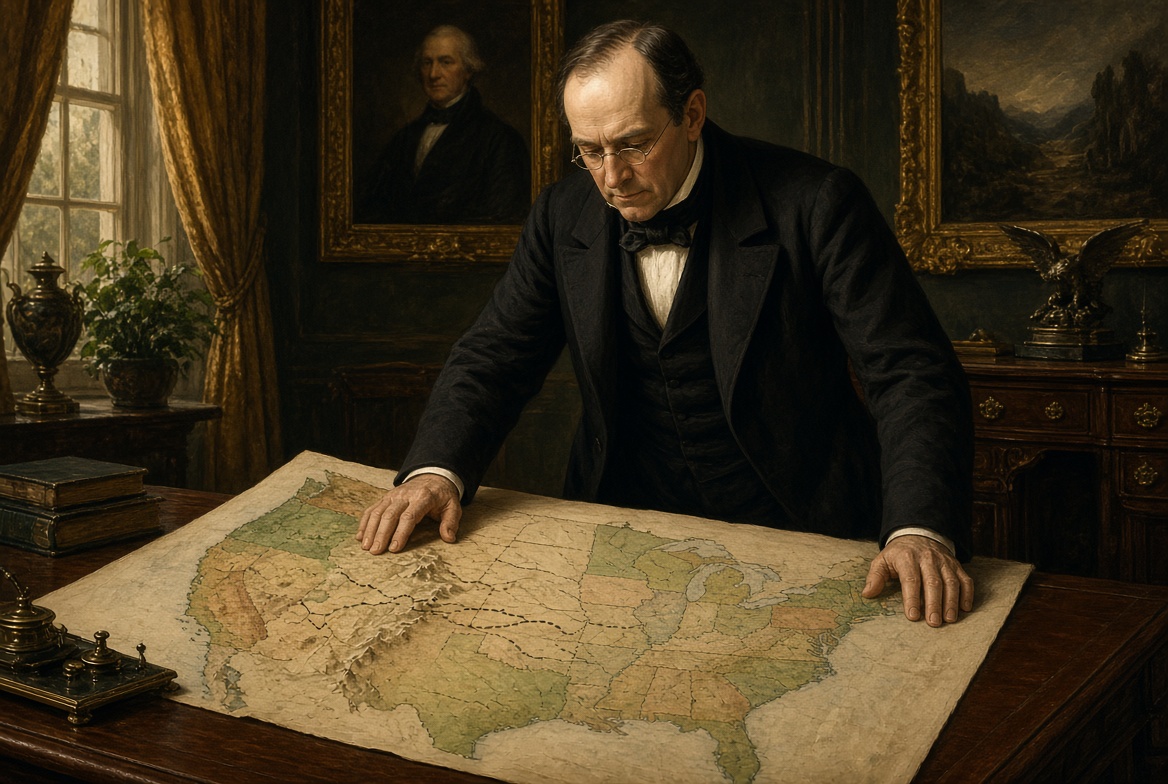
When James K. Polk became president in March 1845, the United States was already looking westward. Many Americans believed the nation was destined to stretch from the Atlantic Ocean to the Pacific. Polk made territorial expansion a central goal of his presidency, and by the time he left office in 1849, the country had acquired an enormous amount of new territory.
So, how did James K. Polk expand the United States? Through the annexation of Texas, negotiations with Great Britain over Oregon, and the Mexican-American War, which ended with the United States gaining control of much of the American Southwest and California.
Polk’s aggressive expansionist policies dramatically changed the country’s borders. However, they also intensified disagreements over slavery, Native American lands, and America’s relationship with neighboring nations.
What Was James K. Polk’s Goal for American Expansion?
James K. Polk was the 11th president of the United States, serving from 1845 to 1849. Before becoming president, he served as Speaker of the House and governor of Tennessee.
Polk campaigned on a platform of territorial expansion. He wanted the United States to secure additional land in the West, strengthen its position along the Pacific Coast, and establish greater opportunities for trade and settlement.
His expansionist vision was closely connected to the idea of Manifest Destiny.
Manifest Destiny was the widely held belief among many Americans during the 1840s that the United States was destined to expand across North America. Supporters viewed westward expansion as an opportunity to spread American political institutions, commerce, and settlement.
However, expansion also involved taking control of lands occupied by Native American communities and other nations, particularly Mexico.
How Did James K. Polk Expand the United States?
Polk accomplished much of his territorial expansion through three major developments: Texas annexation, the Oregon Treaty, and the Mexican-American War.
1. The Annexation of Texas in 1845
Texas became an independent republic in 1836 after breaking away from Mexico following the Texas Revolution.
For several years, American politicians debated whether Texas should join the United States. Supporters favored annexation because it would increase American territory and strengthen the nation’s position in the Southwest. Opponents worried about war with Mexico and the political consequences of adding another slaveholding state.
Shortly before Polk took office, outgoing President John Tyler signed a joint resolution approving Texas annexation on March 1, 1845. Texas officially joined the United States on December 29, 1845, during Polk’s presidency.
Mexico did not recognize the annexation and continued to claim Texas as part of its territory.
The disagreement over Texas also created a serious dispute about its southern border. The United States claimed the Rio Grande, while Mexico maintained that the boundary was farther north at the Nueces River.
This dispute would become one of the factors leading to war between the two nations.
2. The Oregon Treaty of 1846
Another major expansion goal involved Oregon Country, a large territory in the Pacific Northwest claimed by both the United States and Great Britain.
The two nations had previously agreed to joint occupation of the region, but American settlers increasingly demanded that the United States establish control over it.
Polk initially supported American claims extending to latitude 54°40′, near the southern boundary of Russian Alaska. His campaign slogan, “Fifty-four forty or fight!” reflected the strength of this position.
However, Polk ultimately pursued a diplomatic agreement rather than risking war with Great Britain.
In June 1846, the United States and Great Britain signed the Oregon Treaty, establishing the boundary primarily along the 49th parallel.
The agreement gave the United States control of territory that eventually became Oregon, Washington, Idaho, and parts of Montana and Wyoming.
3. The Mexican-American War (1846–1848)
The largest territorial expansion during Polk’s presidency came from the Mexican-American War.
After Texas joined the United States, the border disagreement between the two countries continued. In 1846, Polk ordered American troops under General Zachary Taylor into the disputed territory between the Nueces River and the Rio Grande.
Fighting broke out between Mexican and American forces in April 1846. Polk informed Congress that Mexico had shed American blood on American soil, and Congress declared war on May 13, 1846.
The conflict lasted nearly two years. American forces eventually captured Mexico City in September 1847, putting Mexico under significant pressure to negotiate peace.
The Treaty of Guadalupe Hidalgo
On February 2, 1848, representatives of the United States and Mexico signed the Treaty of Guadalupe Hidalgo.
The agreement officially ended the Mexican-American War and transferred approximately 525,000 square miles of Mexican territory to the United States.
In exchange, the United States agreed to pay Mexico $15 million and assume certain financial claims owed to American citizens.
The newly acquired territory included land that would eventually become:
- California
- Nevada
- Utah
- Most of Arizona
- Most of New Mexico
- Parts of Colorado and Wyoming
Mexico also relinquished its claims to Texas and recognized the Rio Grande as the boundary between the two countries.
How Much Land Did James K. Polk Add to the United States?
Polk’s administration oversaw an enormous expansion of American territory. The following table summarizes the three major developments.
| Event | Year | Territorial Result |
| Texas annexation | 1845 | Texas joined the United States |
| Oregon Treaty | 1846 | U.S. gained control of the Pacific Northwest territory south of the agreed boundary |
| Mexican-American War and Treaty of Guadalupe Hidalgo | 1846–1848 | U.S. acquired approximately 525,000 square miles from Mexico |
Together, these developments helped establish American control across much of the continent, from the Atlantic to the Pacific.
It is important to distinguish Polk’s accomplishments from later expansion. The Gadsden Purchase, which added additional land in present-day southern Arizona and New Mexico, occurred in 1853 under President Franklin Pierce, not Polk.
What Were the Consequences of Polk’s Expansion Policies?
Although Polk achieved his major territorial goals, expansion created significant political and social problems.
One of the biggest disagreements involved slavery. As the United States acquired new territories, politicians argued over whether slavery would be permitted in those areas.
In 1846, Congressman David Wilmot introduced the Wilmot Proviso, which proposed prohibiting slavery in territory acquired from Mexico. Although it never became law, the proposal intensified sectional disagreements between Northern and Southern politicians.
Expansion also came at a tremendous cost to Mexico, whose government lost a substantial portion of its territory. Native American communities living throughout the acquired regions also faced increasing displacement and pressure as American settlement expanded westward.
The new territorial boundaries would continue to influence American politics for decades, contributing to the growing sectional tensions that eventually led to the Civil War.
How James K. Polk Expanded the United States
So, how did James K. Polk expand the United States? He oversaw the annexation of Texas, negotiated the Oregon Treaty with Great Britain, and led the country through the Mexican-American War, which resulted in the acquisition of approximately 525,000 square miles of Mexican territory.
By the end of his presidency in 1849, Polk had helped transform the United States into a continental nation with access to the Pacific Ocean.
However, his expansionist policies also created lasting conflicts over slavery, territorial rights, and relations with Mexico and Native American communities.
James K. Polk’s presidency remains one of the most consequential periods of American territorial expansion. His decisions reshaped the nation’s map and helped establish the geographic boundaries that would define much of the modern United States.
Want to learn more about the presidents who shaped American history? Explore additional presidential biographies, historical events, and stories about the decisions that helped build the United States.