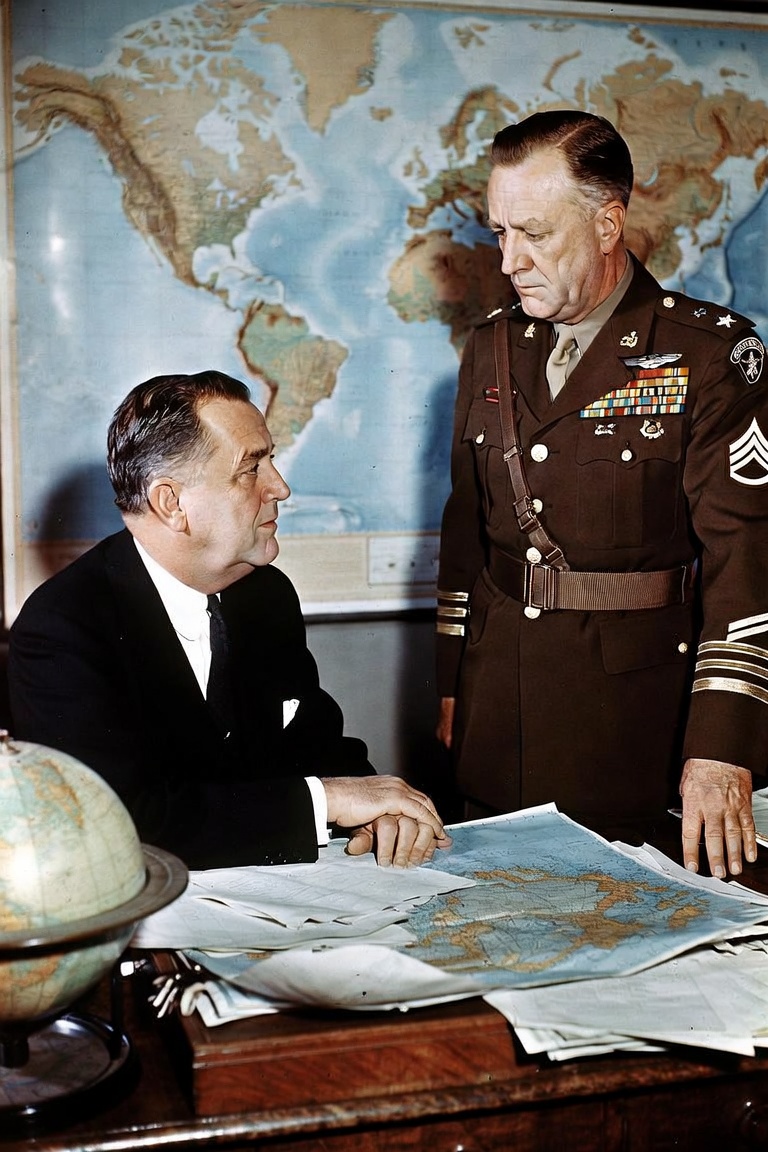
Short answer: World War II dramatically expanded presidential power by increasing the president’s authority over the military, the economy, foreign policy, and the federal government. Under President Franklin D. Roosevelt, the executive branch grew in size and influence as the nation mobilized for war. Many of the responsibilities and expectations associated with the modern presidency can be traced to the changes that occurred during World War II.
Before World War II, presidents certainly exercised significant authority, but the federal government was much smaller, and Congress often played a larger role in shaping national policy. The global conflict that erupted in 1939—and America’s entry into the war after the attack on Pearl Harbor in 1941—required rapid decision-making, massive economic mobilization, and unprecedented military coordination.
As commander in chief, Franklin D. Roosevelt became the central figure directing the nation’s war effort. The powers exercised during the conflict permanently changed the presidency and influenced every administration that followed.
The President Became the Leader of a Global War
The Constitution names the president as commander in chief of the armed forces, but World War II greatly expanded what that role looked like in practice.
Roosevelt oversaw military operations across Europe, Africa, Asia, and the Pacific. He worked closely with military leaders, approved major strategic decisions, and coordinated wartime planning with Allied nations.
Although Congress continued to declare war and approve funding, day-to-day military leadership rested largely with the president and his administration.
Future presidents inherited this expectation that the White House would direct America’s military strategy during international conflicts.
The Federal Government Expanded Rapidly
Winning World War II required an enormous increase in the size and responsibilities of the federal government.
New agencies managed military production, rationing, transportation, scientific research, and labor relations. Millions of Americans entered military service, while factories shifted from producing consumer goods to manufacturing aircraft, ships, tanks, and weapons.
The president supervised much of this mobilization through executive agencies and wartime boards.
By the end of the war, Americans had become accustomed to a much larger and more active federal government than had existed before the conflict.
Roosevelt Directed the Wartime Economy
World War II transformed the president’s role in managing the economy.
Roosevelt’s administration worked with businesses to coordinate production, controlled the distribution of critical materials, encouraged war bond purchases, and supported rationing programs for items such as gasoline, sugar, and rubber.
Federal agencies helped determine what factories produced and how resources were allocated.
Although many of these emergency measures ended after the war, they demonstrated that presidents could play a central role in coordinating the national economy during times of crisis.
Foreign Policy Became a Presidential Responsibility
Before World War II, the United States often avoided long-term involvement in international affairs.
The war changed that dramatically.
Roosevelt worked closely with Allied leaders, including British Prime Minister Winston Churchill and Soviet leader Joseph Stalin, to coordinate military strategy and discuss the future of the postwar world.
Major international conferences at Tehran, Yalta, and other locations placed the president at the center of global diplomacy.
After the war, Americans increasingly expected presidents to lead international alliances, negotiate treaties, and respond to global crises.
Executive Orders Became More Prominent
World War II also highlighted the growing use of executive orders.
Roosevelt signed thousands of executive orders during his presidency, many related to wartime administration and national defense.
Some orders helped organize the war effort, while others remain highly controversial today.
Executive Order 9066 authorized the military to designate exclusion zones, leading to the forced relocation and incarceration of more than 120,000 Japanese Americans during the war. Historians widely regard this policy as one of the most significant violations of civil liberties in American history.
The wartime use of executive authority demonstrated both the expanded powers of the presidency and the importance of constitutional limits during national emergencies.
The President Became the Nation’s Primary Communicator
World War II also changed how presidents communicated with Americans.
Roosevelt regularly addressed the nation through his famous Fireside Chats, using radio to explain military developments, encourage public confidence, and rally support for the war effort.
Millions of Americans listened from their homes, creating a direct connection between the president and the public.
This approach established a new expectation that presidents should communicate frequently during national crises.
Later presidents would use television, and eventually the internet and social media, to fulfill a similar role.
The Creation of a Permanent Global Leadership Role
The end of World War II did not reduce presidential responsibilities.
Instead, the United States emerged as one of the world’s two leading superpowers.
Presidents now oversaw:
- A large standing military.
- Global military alliances.
- Nuclear weapons policy.
- International economic leadership.
- Membership in organizations such as the United Nations.
The presidency became both a national office and a position of global leadership.
How World War II Expanded Presidential Power
| Area | Change During World War II |
| Military leadership | President directed global wartime strategy |
| Executive branch | Federal agencies expanded dramatically |
| Economy | White House coordinated wartime production and resources |
| Foreign policy | President became the nation’s primary diplomatic leader |
| Public communication | Radio strengthened direct communication with citizens |
These changes helped define the modern presidency.
Frequently Asked Questions
Why did World War II increase presidential power?
The demands of a global war required rapid military decisions, economic coordination, and international diplomacy. As commander in chief, President Franklin D. Roosevelt became the central leader of these efforts, expanding the influence of the executive branch.
How did Franklin D. Roosevelt change the presidency during World War II?
Roosevelt oversaw military operations, expanded the federal government, directed the wartime economy, strengthened presidential communication through radio, and played a leading role in shaping postwar international institutions.
Did presidential power remain expanded after the war?
Yes. After World War II, presidents continued to lead global diplomacy, oversee a permanent military establishment, manage international alliances, and play a larger role in responding to national and international crises.
World War II and Presidential Power
World War II fundamentally transformed presidential power in the United States. Under Franklin D. Roosevelt, the presidency became the center of military leadership, economic coordination, foreign policy, and public communication. The enormous responsibilities of leading a nation through global war expanded the executive branch in ways that continued long after the conflict ended.
Modern presidents still operate within the framework that emerged during World War II. From commanding military operations to managing international alliances and responding to national emergencies, many of the expectations placed on today’s presidents can be traced directly to the extraordinary challenges of the Second World War.