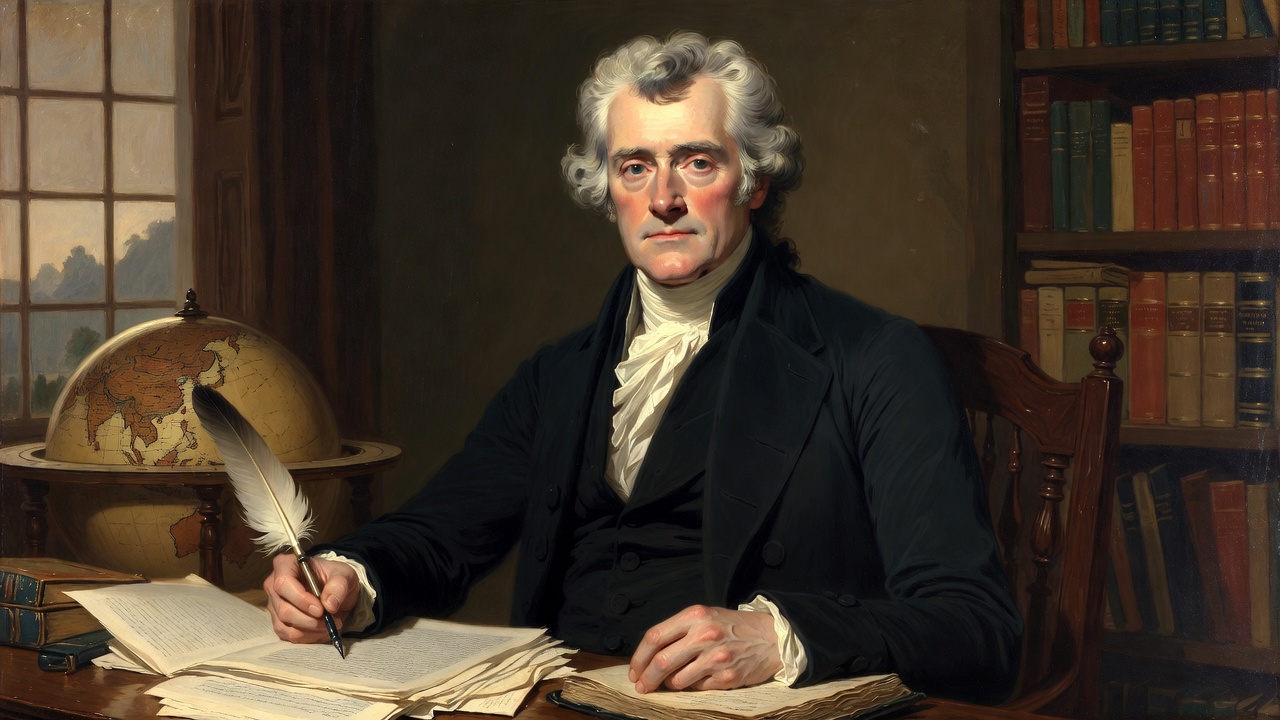
When Thomas Jefferson became president in 1801, the United States was still a young republic clustered mainly along the Atlantic coast. The nation had won independence, but its long-term future remained uncertain. Vast territories to the west were controlled by foreign powers, transportation was difficult, and many Americans wondered how large the republic could realistically become.
Jefferson believed the country’s strength depended on land, agriculture, and opportunity for future generations. During his presidency, he took bold actions that dramatically increased the size, influence, and ambition of the United States. From the Louisiana Purchase to western exploration, Jefferson helped turn a coastal nation into a continental power.
The Louisiana Purchase Doubled the Nation
Jefferson’s most famous achievement was the Louisiana Purchase in 1803. At the time, France controlled the massive Louisiana Territory, which stretched from the Mississippi River to the Rocky Mountains and from the Gulf of Mexico deep into the northern plains.
Jefferson originally wanted to buy only the port city of New Orleans to secure trade access on the Mississippi River. Instead, Napoleon Bonaparte offered the entire territory for $15 million.
The purchase instantly doubled the size of the United States. It gave farmers access to fertile land, secured control of critical waterways, and removed a major European rival from North America. Historians widely view it as one of the greatest land deals in American history.
Jefferson Faced a Constitutional Dilemma
Although Jefferson supported limited government and a strict reading of the Constitution, the Louisiana Purchase presented a challenge. The Constitution did not explicitly state that a president could acquire new territory through purchase.
Jefferson privately worried about whether the deal was constitutional. However, he also recognized the enormous opportunity before him. Rather than let the chance pass, he approved the agreement and sent it to the Senate for ratification.
This decision showed Jefferson’s pragmatism. He was willing to adapt his principles when he believed the nation’s future was at stake.
Opening the West Through Exploration
After acquiring the Louisiana Territory, Jefferson wanted to understand what the United States had gained. He commissioned the Lewis and Clark Expedition, led by Meriwether Lewis and William Clark.
Their mission was to map rivers, study plants and animals, establish contact with Native nations, and search for a route to the Pacific Ocean. The expedition traveled thousands of miles and returned with valuable knowledge about geography, trade routes, and resources.
Jefferson’s support for exploration helped Americans imagine the possibilities of westward growth. It also encouraged migration and settlement in future decades.
Securing Control of the Mississippi River
Before Jefferson’s presidency, access to the Mississippi River was a major economic concern. Western farmers depended on shipping goods downriver to New Orleans. If foreign powers blocked that route, American commerce could suffer badly.
By acquiring Louisiana, Jefferson ensured that the United States controlled the river system that linked western farms to world markets. This strengthened the economy and made western settlement more attractive.
The Mississippi River became a commercial highway that connected expanding frontier communities with eastern cities and international trade.
Encouraging an Agrarian Republic
Jefferson believed the ideal America was a republic of independent farmers. He saw widespread landownership as the best defense against tyranny and corruption. Expanding the nation gave ordinary citizens the chance to own land and build prosperous communities.
The new western territories aligned with Jefferson’s political vision. More land meant more farms, more local self-government, and more opportunity for future generations.
Though the nation would later industrialize, Jefferson’s agricultural ideals strongly influenced early American identity.
Reducing Foreign Threats
Expansion also had strategic benefits. With France gone from Louisiana, the United States reduced the risk of conflict with a powerful European empire in the center of the continent. The purchase also positioned the country to become the dominant force in North America over time.
Jefferson later confronted overseas threats during the First Barbary War, when he sent American naval forces to challenge piracy in the Mediterranean. This demonstrated that expansion of national power was not only about land but also about protecting commerce abroad.
The Contradictions of Expansion
Jefferson’s legacy of growth also included contradictions. Expansion increased tensions over slavery as new territories raised questions about whether slavery would spread westward. It also accelerated pressure on Native American lands and sovereignty.
These issues would grow more serious in later decades. While Jefferson expanded the nation geographically, the moral and political conflicts tied to that expansion remained unresolved.
Why Jefferson’s Expansion Still Matters
Modern America’s continental size owes much to Jefferson’s presidency. The Louisiana Purchase created the framework for future states across the Midwest and Great Plains. Exploration opened routes that later settlers, traders, and railroads would follow.
Jefferson helped transform the United States from a narrow Atlantic republic into a nation with vast interior resources and room to grow.
How he did it
How did Thomas Jefferson expand the nation? He did it through bold diplomacy, strategic vision, and a willingness to seize historic opportunities. The Louisiana Purchase, western exploration, and economic growth during his presidency changed the map of the United States forever.
Jefferson inherited a promising young republic. He left behind a nation with the land, confidence, and momentum to become a continental power.